
AI in Small and Medium-Sized Businesses: From Standalone Tools to a Lasting Competitive Advantage


Why Small and Medium-Sized Businesses Need to Reevaluate How They Use AI Right Now—and What You Can Do Specifically to Stay Ahead of the Curve.
Where do small and medium-sized businesses stand when it comes to AI?
AI is no longer a thing of the future. It’s here. Globally, 78% of organizations now use AI in at least one business function. And generative AI technology—such as ChatGPT and Midjourney—is gaining ground at lightning speed. Yet research by McKinsey shows that many small and medium-sized businesses find themselves in a sort of AI limbo: they’re experimenting with tools but haven’t yet managed to create sustained value.
A gap has emerged between what is possible and what actually happens.
Many organizations limit AI to isolated applications within marketing or customer service. Think of chatbots, automated content generation, or data analysis in spreadsheets. These are good first steps, but they remain small in scope. There is a lack of oversight, coherence, and strategy. AI is seen as “something the IT department does,” not as a tool for driving competitive advantage.
What are the underlying challenges?
The fact that AI is not yet having a significant impact in small and medium-sized businesses is not a matter of unwillingness. It is the result of a combination of recognizable, often logical challenges:
1. AI is being deployed in a fragmented manner
Without a clear vision and structure, AI gets bogged down in experimental projects. There are no economies of scale, let alone strategic returns.
2. Insufficient top-down guidance
CEOs and executive boards often remain cautious. But without leadership at the top, AI will remain confined to the realm of experiments and isolated tools.
3. Uncertainty about ROI
What are the real benefits of AI? Without KPIs and business cases, it’s hard to make decisions—or adjust course if things don’t go as planned.
4. Limited internal capacity
Data scientists, prompt engineers, and AI product owners are in short supply—and often impossible to find for small and medium-sized businesses. This hinders adoption.
5. Employees' Fear of Loss
Without proper communication and training, AI can lead to hesitation: “Will this make my job obsolete?”
The result? Many organizations get stuck viewing AI as a gimmick rather than as a growth accelerator.
What are the options?
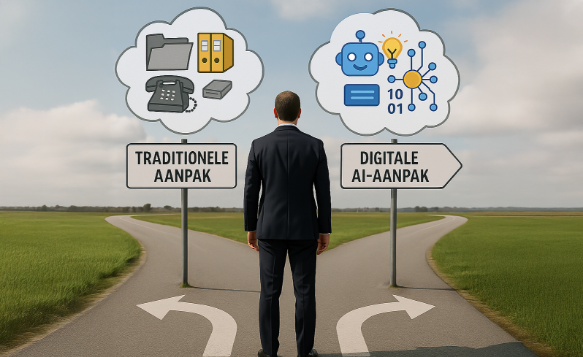
Broadly speaking, there are three paths organizations can take when it comes to AI adoption:
1. Tool-first approach
Get started quickly with user-friendly AI tools for text, images, customer interactions, or dashboards.
Pros: low barrier to entry, immediate applications possible.
Cons: lack of cohesion, no long-term benefits, dependence on external platforms.
2. Use-Case Approach
Targeted use of AI for specific processes or departments (for example: automating quotes).
Pros: measurable impact per case, clear overview.
Cons: fragmentation persists, difficult to scale.
3. Strategic AI Transformation
Embedding AI at the heart of the organization: processes, people, systems, and decision-making.
Pros: sustainable competitive advantage, lower costs, and higher revenue.
Cons: requires leadership, investment, and a willingness to change.
What can small and medium-sized businesses do to gain a long-term competitive advantage?
McKinsey calls it “rewiring the organization.” AI requires more than just technology; it’s more of a strategic reevaluation of how you work, think, and create value.
The key? Don't treat AI as a tool, but as a transformation.
At TMC Media, we believe in five concrete steps that enable small and medium-sized businesses to truly make a difference:
1. Make AI a Top Priority
Appoint a senior executive at the top of the organization to take overall responsibility. AI should not be managed by IT, but by the strategy department.
2. Develop an AI roadmap
Identify where AI adds value in processes, customer interactions, and internal efficiency. Think in terms of quarters, not years.
3. Redesign workflows
AI only really works when you rethink your processes. It’s not about “adding AI” to an old process, but about building the process with AI as the starting point.
4. Establish clear KPIs
Track the impact of AI on costs, lead times, customer satisfaction, and revenue. You can't manage what you don't measure.
5. Invest in people and trust
Reskill your employees. Show them that AI doesn’t replace them, but rather enhances their capabilities. Build trust—both internally and externally.
What are the benefits?
McKinsey’s research shows that organizations that follow this approach realize significant value more quickly:
- EBIT increase to >5% with consistent use of AI
- Cost savings of up to 20% in operations, the supply chain, and IT
- Faster innovation and improved time-to-market
- A Better Customer Experience Through Personalization and Faster Response Times
- Higher employee satisfaction, provided there is adequate support
In conclusion: From Tool to Asset
AI is not the goal; it is the means. But only those who have a clear sense of the goal know which path to choose. Small and medium-sized businesses don’t need to become the next Google or Amazon. But standing still is not an option. The organizations that invest now in vision, leadership, and restructuring are building a sustainable competitive advantage.
Would you like to explore together what AI can do for your organization? At TMC Media, we combine strategic insight with hands-on execution. If you’d like to receive the full McKinsey report, please leave a message via the contact page.
Relevant blogs













































Interested in digital growth for your industry?
Strengthen your online presence and expand your market reach with TMC Media. We combine strategic thinking with innovative creativity to deliver measurable results. From conversion-focused websites to targeted online marketing campaigns—we’re your digital growth partner.
Contact us for a no-obligation consultation
