
The Technical Building Blocks of AI-Friendly Websites


How Technology Is Becoming the Key to Visibility in the Age of Artificial Intelligence
From Search Engine to Answer Engine
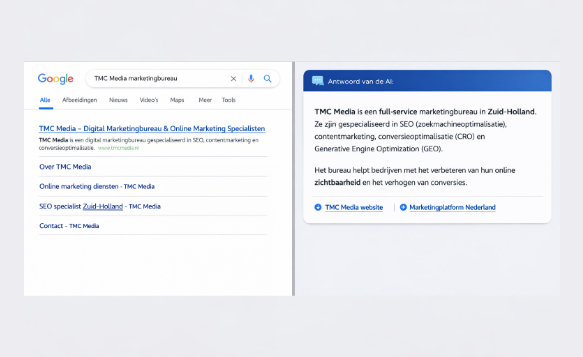
The way people find information online is changing at a rapid pace.
More and more often, we’re no longer asking Google our questions, but rather AI systems such as ChatGPT, Gemini, or Copilot.
These systems don't simply search the web; they understand and reconstruct information.
They determine for themselves which sources are reliable and which content is relevant enough to cite in their answers.
This means that not every website will appear in the search results anymore.
Only sites that are technically well-structured and semantically clear still have a chance of being included in the answers provided by AI.
So the question isn't just “Does my website rank high on Google?”
but also “Can AI understand my website?”
What makes a website AI-friendly?
An AI-friendly website isn't necessarily a technically complex site.
It's a website that communicates clearly, reliably, and in a structured way—not only to people, but also to machines.
There are five fundamental building blocks on which it is based:
structure, speed, semantics, stability, and security.
1. Structure: The Foundation That Helps AI Understand
AI models don't read like humans. They understand content by identifying patterns and relationships in text and code.
A clear structure makes all the difference in whether or not something is included in an AI response.
- Use a logical heading structure (H1, H2, H3).
- Make sure your pages are thematically consistent: one topic per page.
- Build a clear internal linking structure (breadcrumbs, sitemap).
- Avoid duplication or confusion between pages with similar content.
A well-structured site tells machines: “This is important, these elements belong together, this is the context.”
2. Speed: The Invisible Ranking Factor
Speed affects not only the user experience but also AI accessibility.
Slow or unstable sites are often crawled less thoroughly, causing important pages to be overlooked.
Optimize for:
- load time under 2 seconds,
- efficient images (WebP),
- caching and compression,
- server response time under 200 ms.
In an AI ecosystem where information is collected and processed in real time, the rule is: the faster it loads, the faster it is read.
3. Semantics: The Language of Machines
AI doesn't understand design, but it does understand data.
An AI-friendly website uses semantic HTML and structured data (schema.org) to add meaning to content.
Consider:
- product information in JSON-LD,
- FAQ templates,
- company information with Organization markup,
- Article structures including author, publication date, and headline.
Semantics tells AI systems: “This is about a product,” “This is an explanation,” “This is a reliable brand.”
The better the semantics, the greater the chance that AI will recognize and reference your content.
4. Stability: Consistency as a Sign of Reliability
AI search engines use patterns of consistency to assess reliability.
A website that is frequently offline, undergoes structural changes, or moves pages without redirects,
loses its “digital credibility.”
Therefore, make sure that:
- URLs remain stable,
- updates are rolled out in a controlled manner,
- important content retains a fixed position,
- Old pages do not disappear without an alternative link.
An AI system relies on sources that are predictable and consistent.
5. Safety: Trust Through Connection
Unsecured information loses its value.
AI systems and search engines are placing increasing importance on authenticity and security.
Make sure your website meets the following requirements:
- HTTPS certification,
- the latest software versions and security updates,
- clear privacy policy and cookie notice,
- Transparency regarding data processing.
A secure site is not only better protected, but also more highly valued—by both users and algorithms.
Why This Is Important for AI Search
AI systems work differently than search engines.
While SEO focuses on visibility in search results,
AI search focuses on recognition, interpretation, and integration.
That means you don't just want to be found,
but you also want to be understood, cited, and trusted.
Technology plays a crucial role in this:
A website without a clear structure or semantic data is just as unreadable to AI as an image without alt text.
What Companies Can Do Now
- Conduct a technical content audit.
Analyze not only performance, but also semantic completeness and structure. - Have marketing and development work more closely together.
Help developers understand what SEO and AI optimization require—and vice versa. - Implement structured data.
Start with simple schemas such as FAQ, Article, and Organization. - Continue to monitor speed and stability.
Optimization is not a one-time project, but an ongoing maintenance process. - Make AI visibility part of your digital strategy.
Think ahead: How “readable” is your brand to the systems that will shape the future of search behavior?
Conclusion: Technology is now also storytelling
An AI-friendly website isn't just a well-built site,
but a digital story that's structured so clearly that even machines can understand it.
Technology is therefore no longer just the foundation—it is part of the message.
Those who invest in a strong technical foundation today are not only building speed and security,
but also future visibility in a world where AI determines what is seen.
Want to know if your website is ready for the AI era?
At TMC Media, we help companies integrate technology, content, and strategy so that you not only remain visible in search engines but are also discoverable and understandable to AI.
Please contact us to schedule a no-obligation introductory meeting
Relevant blogs





































Interested in digital growth for your industry?
Strengthen your online presence and expand your market reach with TMC Media. We combine strategic thinking with innovative creativity to deliver measurable results. From conversion-focused websites to targeted online marketing campaigns—we’re your digital growth partner.
Contact us for a no-obligation consultation
