
Why a manufacturing company's website is increasingly handling the initial sales conversation


In many manufacturing companies, sales is still seen as a human endeavor. A good conversation over a meal. A technical explanation. An account manager who understands the context. An engineer who inspires confidence with their expertise. That remains important. But the point where that sales process begins is shifting. TMC itself notes that in the B2B buying process, the initial contact is increasingly taking place digitally, and that websites that merely provide information are therefore becoming less effective.
That’s no small matter for manufacturing companies. In this market, value propositions are often technical, products are complex, decision-making is slow, and the number of direct touchpoints is limited. That is precisely why the website plays an increasingly important role—not just as an online business card, but as the first place where a potential customer tries to determine whether your company is relevant, knowledgeable, and trustworthy enough to continue the conversation. TMC is increasingly positioning websites for manufacturing companies and other business organizations as sales channels and growth engines, rather than as passive corporate brochures.
The orientation phase starts earlier and is more digital
The traditional sales process in the manufacturing industry used to be fairly predictable: a prospect would hear about a product through their network, get in touch with the sales team, and only then begin to look into the details. Today, things often happen differently. Google explicitly states that Search is evolving to handle longer, more complex queries and deeper follow-up questions through AI Mode. As a result, business buyers can research a product much more thoroughly before they even make contact.
This is particularly relevant for manufacturing companies, because the questions in this market are rarely simple. It’s not about an impulse purchase, but about applications, reliability, specifications, production capacity, delivery reliability, and industry knowledge. When a buyer, operations manager, or technical decision-maker forms an initial impression online, your website is essentially conducting the first sales conversation—without anyone from your team being present. This shift aligns directly with TMC’s own observation that while sales used to be the starting point of the conversation, that initial moment now takes place digitally.
Technical markets require confidence first
In the manufacturing industry, no one simply buys a solution based on a nice promise. The bar is set higher. Decision-makers seek confirmation that a provider understands their context, can deliver quality, and is suited to the specific challenges at hand. That is precisely why the first impression online has become even more important. A website must not only explain what you make, but also convey why you’re a serious partner. In its content for manufacturing companies, TMC emphasizes that marketing technical products and industrial services is complex, and that digital visibility must be leveraged more intelligently and strategically in this context.
This means that a website has less and less room to remain neutral or general. Whereas a salesperson can provide nuance in a live conversation, the website must make it clear much more quickly what sets your company apart. This is especially important in technical markets, where many providers appear similar on paper. The website must therefore make the difference tangible even before a quote is issued or an initial meeting takes place. TMC also writes about this in the context of positioning for manufacturing companies in saturated markets.
The website doesn't sell by pushing products, but by providing clarity
That’s a key difference from how some companies still view websites. In the manufacturing industry, sales rarely work as a quick conversion trick. It’s much more often about alleviating uncertainty, building trust, and showing that you know what you’re talking about. So the website doesn’t need to “close the deal,” but it does need to fulfill a clear primary commercial function: providing direction.
That role is becoming more important now that digital discovery is increasingly starting in environments where summarization and preselection are key. Google describes AI Mode as an experience that allows users to delve deeper into complex questions and explore them further with follow-up questions. As a result, part of the initial screening process is shifting from humans to the platform and then to the website.
For a manufacturing company, this means that the website must not only provide information, but also organize that information in a way that inspires trust. Not so that someone can “read everything,” but so that they can quickly realize: this company understands my problem.
Specifications alone are no longer enough
Many websites in the manufacturing industry have historically been structured logically. They feature product groups, technical details, certifications, perhaps a list of machinery, and a company profile. That’s understandable, because technical buyers want content. But information alone doesn’t sell. TMC explicitly states this in its article on why a manufacturing company’s website should become its sales channel: industrial websites often contain a lot of information, but yield few conversions when they don’t help visitors make decisions.
That’s exactly why websites are increasingly handling the initial sales conversation. In a real sales conversation, you don’t just state facts; you interpret them. You link them to risks, applications, challenges, and decision criteria. A strong website essentially does the same thing. Not by explaining everything the way an account manager would, but by ensuring that a visitor quickly understands why your company is a good fit for their situation. TMC’s broader approach of “from brochure to lead machine” ties directly into this.
The first conversation is increasingly taking place before the click
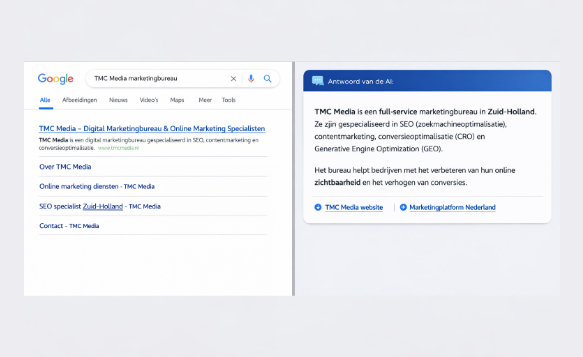
The shift goes even further. By 2026, first impressions of brands will increasingly be formed through an AI summary, a response interface, or a comparative search experience. Google says that AI Overviews and AI Mode are designed to help people immediately with more complex questions. In its ChatGPT shopping research, OpenAI also describes a model in which users first receive a personalized guide and summary, and only then make further decisions. Although that example is more consumer-focused, it does show that digital preselection is increasingly taking place before a traditional website visit.
For manufacturing companies, this means that the website is increasingly becoming the second step, rather than the first. But that’s precisely why the website needs to be better. Because once a prospect clicks through, they’re no longer coming in with a blank slate. They already have context, have made an initial comparison, and have formed a preliminary opinion. Your website must then immediately confirm that your company is worth continuing the conversation with.
In complex B2B markets, the website acts as a filter
That may well be the biggest change. The website is no longer just a source of information for interested parties. It has also become a filter in the selection process. Visitors assess whether your manufacturing company is large enough, specialized enough, professional enough, and relevant enough for their project. This happens in the blink of an eye. TMC therefore describes the modern website as a combination of discoverability, persuasion, and lead generation.
That filtering effect isn’t a bad thing. On the contrary. For manufacturing companies with a strong value proposition, this is actually an opportunity. A good website not only helps attract more visitors, but also helps retain the right visitors more quickly. That makes the website more commercially valuable than it used to be—not because it replaces sales, but because it better prepares the ground for sales.
Sales and the website are converging
In many industrial organizations, marketing and sales are still separate worlds. The website is “marketing’s domain,” while the actual sales conversation is “sales’ domain.” But that separation is becoming less tenable. If your website is the first point of commercial contact, then it’s not just marketing material—it’s part of the sales process. TMC positions its work for manufacturing companies precisely at that intersection: attracting new customers through targeted marketing campaigns and optimizing online sales channels.
That’s an important insight for executive teams and sales teams in the manufacturing industry. A website doesn’t have to be visually appealing just for the sake of it. It must contribute to business growth. It must enhance the quality of the initial conversation, even if that conversation is still entirely digital.
Why this is such a great opportunity, especially for manufacturing companies
Many manufacturing companies have a great deal to offer in terms of substance, but are still too hesitant when it comes to communicating online. Their expertise lies in their people, processes, and solutions, but on their websites, this often gets lost in generic text or product lists. This creates a gap between what the company is truly capable of and what a prospect experiences online. In its content for manufacturing companies, TMC already highlights this tension: technical companies are often too modest online, while sharp positioning and AI visibility are becoming increasingly important.
That’s exactly where the opportunity lies. Because when the website handles the initial sales conversation, it’s not automatically the largest company that wins. Often, the winner is the company that comes across most clearly online—the one that builds trust more quickly, and the one that does a better job of showing which types of customers and challenges it’s relevant for.
Google isn't going away, but the website's role is changing
It’s not a matter of “Google in the past, AI now.” Google remains a crucial starting point, but the way people search is changing. Google is making Search more interactive and better suited for complex questions through AI Overviews and AI Mode. As a result, user behavior is shifting along with it: less linear, more exploratory, and more conversation-driven.
The website therefore remains essential, but no longer merely as the end point of a search. It is increasingly becoming the decision-making moment in a broader digital customer journey. For manufacturing companies, this is perhaps the most important development today. Because especially in markets where trust, content, and practicality carry significant weight, a strong website can make a huge difference in who ultimately reaches out.
Conclusion
A manufacturing company’s website is increasingly serving as the first point of contact in the sales process, as buyers are conducting their research earlier, more digitally, and in greater depth than before. In a market characterized by complex products, long sales cycles, and high expectations for trust, this is not a minor detail but a strategic shift. TMC’s own content already clearly reflects this trend: websites are evolving from brochures to lead-generation tools and from supporting channels to pivotal touchpoints.
For manufacturing companies, this means that a website should no longer just show that you exist, but—more importantly—why a prospect would want to continue the conversation with you. Not as a replacement for sales, but as the first commercial step leading up to it. And that is exactly why, in the manufacturing industry, the website is increasingly becoming the first sales conversation.
Want to know if your website is already capable of serving as an initial sales conversation? TMC Media helps manufacturing companies transform their websites from information hubs into commercially powerful digital channels. Feel free to contact us for a no-obligation introductory meeting.
Relevant blogs















































Interested in digital growth for your industry?
Strengthen your online presence and expand your market reach with TMC Media. We combine strategic thinking with innovative creativity to deliver measurable results. From conversion-focused websites to targeted online marketing campaigns—we’re your digital growth partner.
Contact us for a no-obligation consultation
