
The first impression of your B2B company is increasingly formed before the click


For years, the online landscape in B2B was straightforward. A potential customer would search on Google, compare a few results, click through to a website, and only then form a first real impression of the company. The website was the starting point for getting to know the company.
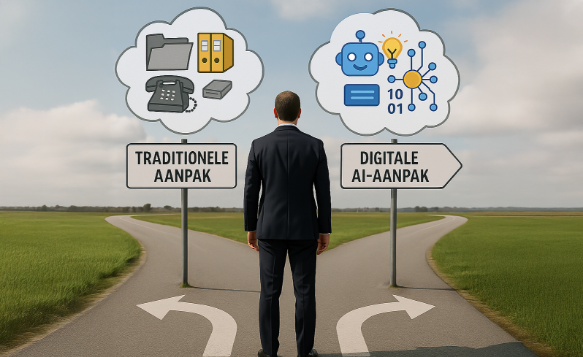
But that pattern is changing.
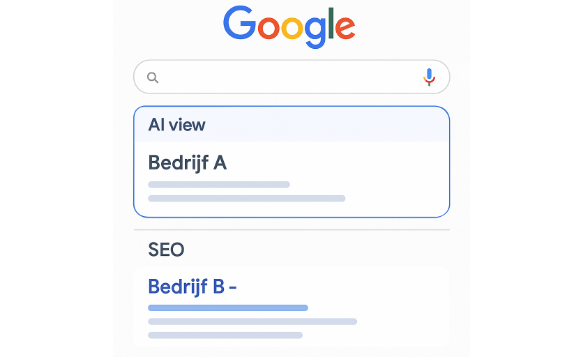
Today, that first impression is increasingly formed before a user even visits a website. Google is continuing to expand Search with AI Overviews and AI Mode, which provide users with instant summaries and allow them to ask follow-up questions. At the same time, platforms like ChatGPT are increasingly establishing themselves as places for research, comparison, and exploration. As a result, part of the initial brand experience is already shaped before someone even lands on your site.
For B2B companies, this represents a fundamental shift.
The classic B2B customer journey still exists, but it starts differently
In many B2B markets, the customer journey is long, rational, and multi-layered. There are multiple decision-makers, longer deliberation periods, and higher risks. That is precisely why the website was so important for so many years: that’s where the in-depth exploration began. It was there that a company could explain what it does, what it excels at, and why it is a reliable partner.
That role remains important, but the starting point is shifting.
Google is making the transition from search query to conversation increasingly seamless. In AI Overviews, users receive an answer directly on the results page, and from that answer, they can ask follow-up questions right away in AI Mode. Google has also rolled out Gemini 3 as the default model for AI Overviews, specifically to make that layer of responses stronger and more natural.
This means that a person’s first encounter with your company is less and less likely to start with a click on your homepage or services page. Instead, it’s increasingly likely to begin with a summary, comparison, or contextual recommendation found elsewhere.
In B2B, this shift is particularly relevant
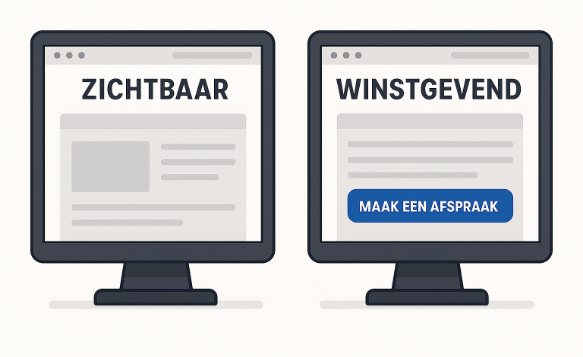
In consumer markets, quick research has long been the norm. In B2B, it sometimes seems as though everything still revolves around face-to-face conversations, demos, and quotes. But even business decision-makers are increasingly starting their research digitally and independently. TMC Media itself notes that B2B companies must remain visible in an era where AI Overviews are taking over part of the search journey, and that websites must increasingly evolve from digital business cards into lead-generation tools.
That makes sense. Business buyers want to determine early on whether a prospect is relevant enough to warrant further investigation. They want to know more quickly whether a supplier or service provider understands their needs, whether there is sufficient expertise, and whether a company comes across as professional and credible.
As that initial assessment increasingly takes place through an AI-generated response, a summary, or a search experience without a direct click, the way a brand builds trust is also changing.
The first impression will be more compact and faster
That may well be the most important change.
In the past, as a B2B company, you had more leeway to gradually build context on your website. A visitor would click through, read several pages, and form an opinion step by step. Now, that first impression is more often condensed into a few lines of context, a summary of expertise, or a list of recommended options.
That speeds up the review process.
And in B2B, that’s not something to take lightly. Because if a potential customer thinks—even before clicking—that this company seems too generic, not distinctive enough, or not quite the right fit, you might not even make it to the actual consideration phase. The reverse is also true: those who come across as credible and relevant early on are more likely to secure a spot on the shortlist.
The website remains important, but it is no longer always the first point of contact
That doesn't mean websites are becoming less important. On the contrary.
The website remains the place where depth, evidence, and conviction come together. But its role is changing. Increasingly, the website is no longer the very first point of contact, but rather the place where a first impression is either confirmed or dispelled. TMC Media has already written about this: the website should not only inform, but also contribute to lead generation, visibility, and commercial progress.
For B2B companies, this is a crucial insight. Because when someone visits your website after already gaining context through AI search or other summarizing interfaces, that visitor approaches it differently. Less of a blank slate. More probing. More selective.
Your website doesn't have to start from scratch. But it does need to immediately confirm that the first impression is accurate.
AI search is changing the order of persuasion
In the classic funnel, visibility came first, followed by a click, then an explanation, and finally trust.
In this new reality, trust is taking center stage—not entirely, but noticeably so. Google’s AI Mode is explicitly designed to answer more complex questions, allowing room for follow-up questions and deeper exploration. OpenAI positions ChatGPT shopping research in a similar way—as an experience that clarifies questions, researches sources, and then builds a personalized guide. Although that example isn’t purely B2B, it does show that digital orientation is increasingly taking place in a conversation that precedes the traditional website experience.
For B2B, this means that the sequence of persuasion is changing.
A brand must not only perform well where the click lands, but also at the points where the initial selection is made.
Visibility alone is no longer enough
Many B2B organizations still focus heavily on online traffic, rankings, and reach. While these remain valuable, they no longer tell the whole story.
After all, what good is visibility if the initial context surrounding your brand is weak or unclear? What good is traffic if the first impression has already been formed elsewhere—and it’s not in your favor?
That is precisely why brand clarity is becoming more important—not as an abstract branding term, but as a commercial reality. A B2B company that clearly communicates online what it stands for, who it is relevant to, and how it stands out increases the likelihood that that first impression will be positive, even if it is formed before the user clicks.
TMC itself strongly emphasizes this shift: from being sought out to being the answer, within an ecosystem where content, platform, and commercial follow-up converge.
This affects not only marketing but also sales
That makes this topic directly relevant to sales teams.
When the first impression of your B2B company is often formed before the click, the sales process begins sooner than many organizations realize. Not just when someone fills out a form or requests a demo, but the moment your brand appears in a summary, shortlist, or list of results.
This means that marketing and sales can’t operate as separately as they used to. Marketing doesn’t just build reach; it also influences how well sales conversations get off to a start. And sales benefits not only from more leads, but from leads that already come in with a stronger first impression.
For specialized B2B companies, this is actually an opportunity
This development is not only a threat; it also presents opportunities.
B2B companies with specialized expertise, clear positioning, and credible content can actually benefit from this shift. In an environment where users want to quickly identify which companies are relevant, those that come across as clear have an advantage—especially when their market is complex and trust is a major factor.
This also aligns well with TMC’s broader approach to B2B: human creativity and strategic insight remain essential, but must be intelligently enhanced by technology and AI.
Google remains important, but it's no longer the only one
So it's not a story of Google versus AI.
Google itself is increasingly becoming an AI-driven environment. In addition, new touchpoints are emerging in tools like ChatGPT. As a result, the first impression of a B2B company is becoming less dependent on a single click and more spread out across multiple digital touchpoints.
For businesses, this means that online visibility must be viewed from a broader perspective—not just as an SEO issue, but as a matter of brand perception, commercial positioning, and digital persuasiveness.
Conclusion
The first impression of your B2B company is increasingly formed before the click, as search behavior changes. Users are presented with summaries, answers, and recommendations earlier on, and as a result, they form an opinion before they even visit your website. Google is accelerating this trend with AI Overviews and AI Mode, and other AI platforms are also increasingly shifting toward research and pre-selection.
For B2B companies, this means that the website remains important but takes on a different role. Less as a first point of contact, more as a confirmation of an impression that has already been formed elsewhere. Companies that are responding to this trend now are not only improving their discoverability but also building a stronger commercial foundation. This aligns directly with TMC’s own vision: from a digital business card to a lead generator, and from simply being found to actually being relevant in the new reality of search.
CTA
Wondering how your B2B company comes across today before a visitor even lands on your website? TMC Media helps companies make their online visibility, brand story, and digital persuasiveness future-proof.
Relevant blogs

















































Interested in digital growth for your industry?
Strengthen your online presence and expand your market reach with TMC Media. We combine strategic thinking with innovative creativity to deliver measurable results. From conversion-focused websites to targeted online marketing campaigns—we’re your digital growth partner.
Contact us for a no-obligation consultation
