
How can you ensure that your company is mentioned in AI responses?


AI tools such as ChatGPT, Perplexity AI, and Google Gemini are rapidly changing the way people search for information and make decisions. While search engines have long been focused on displaying lists of links, we are now seeing a clear shift toward direct answers.
For businesses, this represents a fundamental shift. It’s no longer enough to be easy to find on Google. The question being asked more and more often is: Is your business mentioned in the answer provided by AI?
In this article, we explain how that works and what specific steps you can take to build that visibility.
What does “being mentioned in AI responses” mean?
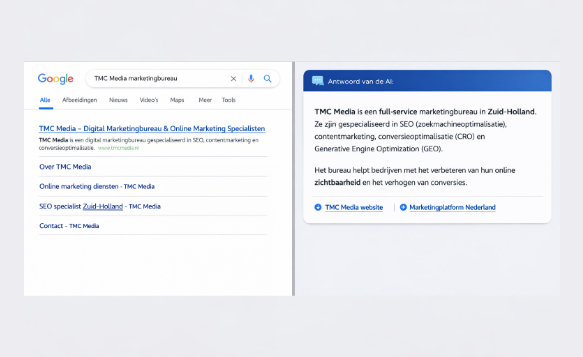
When someone asks an AI tool a question, they usually don’t receive a list of websites, but rather a summary of information. That response sometimes mentions companies, but often it doesn’t.
That difference is crucial. If your company isn’t included in that summary, then at that moment you’re simply not part of the user’s consideration. As a result, you lose visibility even before anyone starts looking for suppliers.
So it's no longer just about being found, but about being included in the answer itself.
Why This Goes Beyond Traditional SEO
Traditional SEO focuses on achieving high rankings in search engines. You try to rank higher than your competitors so that users click through to your website. That model is changing.
With the rise of AI, the focus is shifting to what is also known as Answer Engine Optimization and Generative Engine Optimization. Instead of optimizing solely for search engines, you’re optimizing for systems that generate answers.
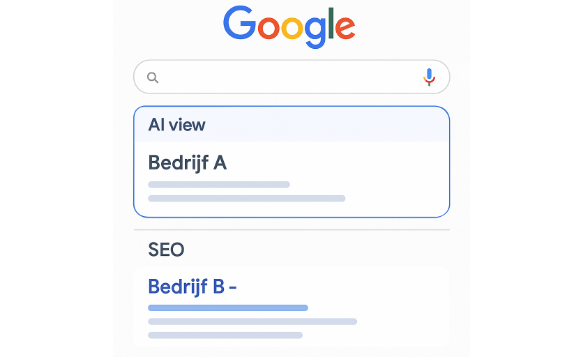
The main difference lies in the end result. While SEO is all about clicks, GEO is all about trust and selection. AI systems generate a summary and use it to identify which sources or companies are relevant. Only a small number of entities are mentioned, which effectively makes the competition fiercer than ever.
How does AI determine which companies are mentioned?
AI systems base their responses on a combination of signals. No single factor is decisive, but certain elements recur consistently.
First and foremost, subject-matter authority plays a major role. Companies that consistently publish valuable and substantively strong content are more likely to be included. In addition, AI assesses how clearly your expertise is demonstrated. If it’s not clear what you stand for, it becomes difficult for a model to position you in an answer.
The structure of your content is also important. Pages that answer questions directly are easier to interpret and reuse. Finally, consistency matters. If your name and expertise appear in multiple places, AI is more likely to recognize you as a relevant source.
Seven Ways to Increase Your Chances of Being Mentioned
1. Answer specific customer questions
The foundation starts with understanding the questions your target audience asks. Think of questions that come up in sales conversations, or questions that prospects ask before they reach out.
By incorporating these questions directly into your content, you’ll be aligning your content with the type of input users provide to AI. This increases the likelihood that your content will be used as a source.
2. Write using a clear question-and-answer structure
AI systems work best with clear structures. A page that explicitly asks a question and answers it directly is easier for an AI to process than a general narrative.
Therefore, make sure to use important questions as headings and provide the answer right in the first paragraph. This not only makes your content easier to read but also more useful for AI.
3. Build authority around specific topics
A single blog post is rarely enough to be seen as an expert. Authority is established when you publish multiple articles on the same topic.
By creating clusters of related content, you demonstrate a broad and in-depth understanding of a topic. This helps AI associate your business with specific themes.
4. Be specific and avoid abstract language
Much marketing content gets bogged down in general statements. For AI, these are weak signals. Concrete information—such as figures, examples, and clear definitions—is picked up more quickly.
A statement like “good content is important” adds little value. A statement like “B2B websites convert at an average rate of between 1% and 3%” is more specific and therefore more valuable.
5. Ensure clear positioning
AI needs to be able to understand what you do and for whom. The more specific your positioning, the easier it is to place you in the right context.
A general description makes it hard to stand out. A clear focus—for example, on a specific industry or service—increases the likelihood that you’ll be included in relevant results.
6. Work on increasing your visibility outside your own website
AI doesn't just look at your own content, but also at how often and where you're mentioned. External signals play an important role in how trustworthy and relevant you're perceived to be.
Publications, collaborations, case studies, and mentions on other platforms all contribute to your visibility. The more consistently your name appears, the stronger the signal.
7. Use FAQ sections strategically
Frequently asked questions are directly related to how people use AI. By explicitly answering these questions on your pages, you increase the likelihood that your content will be shared.
FAQ sections also allow you to address multiple variations of a question, which further increases your visibility.
Common Mistakes That Limit Your Visibility
A common pitfall is using generic marketing language without any concrete content. This makes it difficult for AI to determine the value of your content.
In addition, we often see that companies have positioned themselves too broadly. Without a clear focus, it becomes difficult to truly establish authority in any particular area. There is also a frequent lack of demand-driven content, which means there is simply no relevant input for AI to draw upon.
Finally, the depth of the content is sometimes limited. Superficial articles do not provide sufficient guidance and are less likely to be used in responses.
What does an AI-proof article look like?
An article that works well for both SEO and GEO has a number of recognizable characteristics. The title contains a clear question, the introduction provides an immediate answer, and the rest of the text elaborates on this in a structured way.
In addition, the article includes concrete examples, clear subheadings, and a logical structure. The goal is not just to be found, but to be understood and put to use.
The Shift from Searching to Asking Questions
Users' search behavior is clearly changing. Whereas short search terms were used in the past, we are now seeing complete questions more and more often.
Instead of searching for “marketing agency for the industry,” for example, someone might ask which agency can help with lead generation in the industry. AI then provides an immediate answer and selects a limited number of agencies.
That means visibility is becoming increasingly dependent on how well you address these questions.
Conclusion
Standing out in AI-generated answers requires a different approach than traditional SEO. It’s not just about rankings, but about relevance, clarity, and authority.
Companies that invest in answering real questions, building in-depth content, and strengthening their positioning significantly increase their chances of being included in AI-generated answers. Need help getting found by AI? We at TMC Media are happy to help! Schedule a no-obligation introductory meeting!
Relevant blogs


!.png)
















































Interested in digital growth for your industry?
Strengthen your online presence and expand your market reach with TMC Media. We combine strategic thinking with innovative creativity to deliver measurable results. From conversion-focused websites to targeted online marketing campaigns—we’re your digital growth partner.
Contact us for a no-obligation consultation
