
Shopify SEO is changing. AI visibility is becoming the new traffic channel


For years, the logic behind e-commerce was pretty clear. You optimize your online store for Google, climb in the search results, attract more visitors, and increase your revenue. That foundation remains important, but the reality is changing rapidly. More and more often, the initial brand selection is already taking place in AI responses from sources such as Google AI Overviews, AI Mode, and other generative search environments. Google itself says that these AI experiences are causing people to search more often, ask more complex questions, and click through to the web via links.
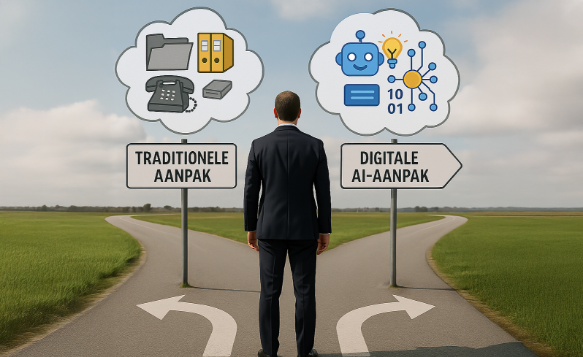
For brands with a Shopify store, this has fundamental implications. You’re no longer just competing for a spot in traditional search results. You’re also competing to be included in the answer an AI system provides to a potential customer’s question. That’s exactly where a new playing field for online discoverability is emerging.
From Ranking to Recommendation
In traditional SEO, much of the focus is on rankings, category pages, product pages, and organic traffic. In AI-driven search environments, the focus is shifting. It’s not just about “Do I rank high on Google?” but also “Does an AI system understand my brand, my products, and my expertise well enough to mention me, summarize me, or recommend me?” Shopify now explicitly describes this development as AEO and GEO. These are strategies for gaining visibility in AI search engines and generative responses.
This is particularly relevant during the exploration phase of the customer journey. A buyer, engineer, or end user no longer searches solely by product name. Instead, they ask questions such as: Which solution best suits my application? What is the difference between two variants? Which supplier is best suited for a specific industry? Or which online store offers the right combination of price, availability, and expertise? It is precisely for these types of questions that AI can already make an initial selection before someone clicks through to a website.
Why This Is Important for TMC's Shopify Customers
For TMC customers who use Shopify, this is not just some abstract trend. It directly affects how their online store is discovered, understood, and chosen.
A Shopify store that consists solely of product titles, a short description, and a price runs the risk of being less visible in AI search environments. A Shopify store with rich product data, clear categories, uses, specifications, FAQs, manuals, comparisons, and industry context, on the other hand, has a much greater chance of being included in answers and recommendations. Google emphasizes that structured data and machine-readable content help it better understand content and product information. For e-commerce, Google explicitly cites this as a way to improve the accuracy of its interpretation.
This aligns seamlessly with the approach TMC already implements for many clients. Not just a visually appealing store, but one that makes sense in terms of content—a store where the product structure, taxonomy, filters, technical specifications, applications, and supporting content are organized logically. It is precisely this combination of content, context, and data structure that is now more important than ever.
The online store must be readable by both people and machines
The next phase of SEO requires a broader perspective. An online store must not only function well for visitors, but also be easily readable by search engines and AI systems.
It starts with the basics. Google recommends using structured data for e-commerce so that systems can better interpret price, availability, reviews, shipping information, and other product attributes. However, there is one important condition: the structured data must match the visible content on the page and must not be misleading.
In practice, this means that Shopify stores benefit from:
· complete and consistent product information,
· clear product titles and variants,
· accurate price and inventory information,
· robust category and filter structures,
· content that answers real customer questions,
· and trust indicators such as company information, expertise, and supporting documentation.
For B2B online stores, this is even more crucial. The more specialized the product, the more context is needed to position it effectively. An AI system must be able to understand what the product does, in which applications it is relevant, which materials or systems it works with, which standards or certifications apply, and what type of customer it is intended for. Without that context, an online store’s content remains too thin.
The role of content is changing
Many companies still view content primarily as a means of driving additional traffic. But in the age of AI, content takes on a second function. Content not only helps you get found, but also helps you be understood.
That calls for different priorities. Not more thin pages, not mass-producing generic AI-generated content, but rather creating content that actually solves real problems. Google is clear on this. AI can be useful in the content creation process, but content published on a large scale without real added value may violate the spam guidelines. Quality, originality, and usefulness to the visitor remain the guiding principles.
For Shopify customers, this means that product content and knowledge content need to become more closely integrated. Today’s strong online store consists not only of products and categories, but also of use cases, buying guides, comparison pages, FAQs, how-to content, and supporting information that demonstrates the brand’s true expertise on the subject.
What TMC Customers Should Do Now
For existing Shopify customers, now is the perfect time to view their store not only as a sales channel, but also as a data source and knowledge platform.
The first step is to organize the product structure. Have all fields been filled in logically? Is there consistency in names, variants, specifications, and attributes? Is the information usable for filters, search functionality, and structured data?
The second step is to enhance the context. Does each product or category include sufficient information to make it clear—both to an AI system and to a user—when it is relevant? Are there use cases, industry pages, applications, or FAQs available?
The third step is technical enrichment. This includes structured data, accurate business information, product markup, and—where relevant—additional signals that help search engines better understand your brand and offerings. Google recommends JSON-LD as the format for this.
The fourth step is building authority. AI systems don’t just select based on product data, but also on credibility and context. Brands that consistently explain what they do, who they serve, and why their solution is relevant have a stronger starting position.
From an online store to an AI-ready commerce platform
The trend that is now emerging is changing Shopify’s role. The platform remains a powerful e-commerce engine, but the way traffic is generated is changing. It’s no longer just through traditional rankings, but increasingly through AI-driven discovery.
This calls for a different approach to online growth. It’s not just about focusing on sessions and rankings, but also on digital visibility across the board. Is your brand mentioned? Are your products understood correctly? Do you appear in answers to commercial and content-related questions? Are you present when an AI system compiles the shortlist?
This presents a clear opportunity for TMC. Shopify implementations must not only be conversion-focused and visually appealing, but also rich in content, technically sound, and AI-ready. The brands that invest in this now are building a head start in the next era of e-commerce.
No, Shopify SEO hasn’t gone away. The playing field has expanded. In addition to visibility in search results, a new channel is emerging: visibility in AI responses. For TMC clients, this presents an opportunity—provided their online store is more than just a storefront.
The winners in the coming years will be the brands that set up their Shopify environment as a combination of commerce, content, and structured knowledge. This isn’t just good for Google—it’s also good for the AI systems that are increasingly influencing customers’ initial choices.
Relevant blogs


























































Interested in digital growth for your industry?
Strengthen your online presence and expand your market reach with TMC Media. We combine strategic thinking with innovative creativity to deliver measurable results. From conversion-focused websites to targeted online marketing campaigns—we’re your digital growth partner.
Contact us for a no-obligation consultation
