
The new customer journey doesn't always start on Google anymore


For years, the playing field was straightforward. Someone had a question, typed it into Google, clicked on a search result, and landed on a website. For many companies, that was the standard starting point for online visibility. Those who ranked well on Google were involved early in the customer journey and had a strong starting position.
But that logic is changing.
After all, the new customer journey no longer always starts on Google. More and more often, users begin their search in an AI environment, on a social platform, in a browser with a built-in assistant, or in an environment where they expect an immediate answer rather than a list of links. Google itself is moving in that direction with AI Mode and more comprehensive AI Overviews; ChatGPT is developing shopping and research experiences; and Copilot is already helping users summarize, compare, and make decisions while they browse.
That doesn't mean Google is going away. It does mean, however, that Google is no longer automatically the only starting point.
From Search Engine to Decision-Making Environment
The traditional customer journey began with a search query. Today, we’re seeing something different emerge: a user asks a question in natural language, immediately receives context, next steps, summaries, and suggestions, and decides based on that which brands remain in the running.
That’s a fundamental shift. Users are no longer just looking for information. They’re looking for direction, validation, and speed.
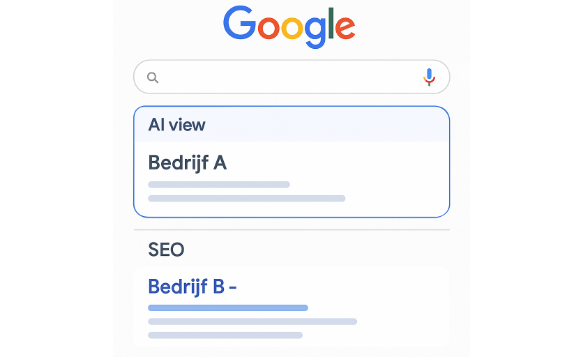
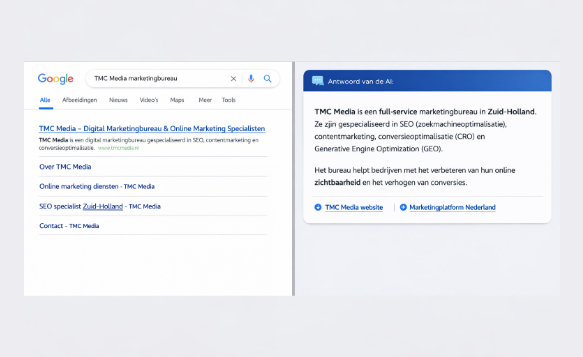
This also changes the role of online visibility. It’s less about simply “being found” and more about “being mentioned, understood, and trusted” in the places where decisions are made. A brand that appears in Google but doesn’t show up in AI responses, comparisons, or contextual recommendations may still be visible yet still miss out on part of the journey.
Why this is important right now
This development is no longer a distant prospect. Google is explicitly positioning AI Mode as a more powerful search experience in which users can ask follow-up questions and delve deeper. This makes searching less linear and more conversation-driven. At the same time, OpenAI continues to build out shopping research and commerce experiences within ChatGPT. And with ads appearing in ChatGPT, it’s also becoming clear from a commercial perspective that platforms expect decisions to be made there more and more often.
This has major consequences for businesses.
Because if people’s first encounter with your brand no longer comes from an organic click, you need to ask yourself a different question: at what points in the customer journey am I still visible, relevant, and credible?
That is the real challenge we face today.
That first click is no longer a given
Many organizations still measure their online success using an outdated model: impressions, clicks, sessions, and conversions. While this remains valuable, it no longer tells the whole story.
In an AI-driven customer journey, a user can get much further without visiting your website right away. Think of someone who is researching a service, comparing products, creating a shortlist, or asking an AI system for advice. At that point, an impression is already being formed. Preferences are already emerging. Selections are already being made.
So the website hasn’t disappeared, but its role is shifting. Not every visitor starts there. Increasingly, people only visit the website once a brand has already been considered. That makes the intermediate phase more important than ever: the phase in which platforms, models, and assistants determine which names are even mentioned.
What This Means for Brands
The brands that succeed in this new customer journey aren't necessarily the ones with the most content. They're the brands that are clear enough at the right moment.
Clear about what they do.
Clear about who they’re here for.
Clear about why they can be trusted.
Because in an environment where answers are summarized and choices are filtered more quickly, vagueness is a disadvantage. Companies with a fragmented narrative, unclear positioning, or interchangeable content are more likely to simply fail to make the cut in the decision-making process.
That is precisely why brand clarity is becoming more important—not as branding separate from performance, but as a strategic prerequisite for digital visibility.
The customer journey is expanding beyond search alone
What we’re seeing now is that search, content, social media, and AI are becoming increasingly intertwined. Users discover something on social media, learn more about it using an AI assistant, compare options in a chat environment, and only then visit a website or request a quote directly.
As a result, the customer journey becomes less channel-driven and more context-driven.
For marketers, this means that the old silos are less effective. Anyone who views SEO in isolation from content, content in isolation from the brand story, and the brand story in isolation from conversion is missing the big picture. Tomorrow’s visibility doesn’t come from a single channel, but from an ecosystem in which every component conveys the same level of trust. That is precisely why AI search is not just a technical issue, but also a strategic one.
Trust is becoming a greater competitive advantage
In a traditional search engine, you could still make up for a lot with ranking. In an AI-driven environment, trust carries more weight. Platforms want to display answers that are logical, useful, and credible. Users want brands that come across as clear, knowledgeable, and consistent.
That means that an online presence is no longer just about reach. It's about reputation.
Who is mentioned?
Who is considered trustworthy?
Who provides clear answers?
Who has a consistent narrative across the website, in content, in reviews, and elsewhere online?
The brands that perform well in this area aren't just building discoverability. They're building a preferred position.
Why This Is Also Good News
This shift may sound threatening to some companies, but it actually offers opportunities as well.
Why? Because the new customer journey is less about volume and more about relevance. Large players still have an advantage, but smaller, sharply positioned brands can actually come out on top when they communicate clearly, are recognizable for their expertise, and make themselves visible at the right moments.
That doesn't make the market any easier, but it does make it more interesting. Because the playing field is shifting from “who has the most pages?” to “who is considered the most relevant in the context of the query?”
And that is exactly where strong brands can set themselves apart.
Google remains important, but it's no longer the only one
Let's be clear: Google remains a crucial part of online visibility. It's just that Google's role is evolving. Search has become less static, more interactive, more answer-driven, and more intertwined with AI.
The mistake companies can make right now is thinking in terms of "either/or."
Whether it's SEO or AI.
Whether it's Google or ChatGPT.
Whether it's a website or a platform.
The reality is that it’s both-and. The new customer journey calls for a broader presence—not just where people search, but also where they compare, ask questions, have doubts, and make decisions.
What does this mean for your organization?
The most important question is not whether this change is coming. That change is already underway.
The question is: Is your brand visible when it matters most?
If your customer journey is still entirely based on the old model of keywords, clicks, and landing pages, now is the time to reevaluate your digital strategy. Not out of panic, but to stay ahead of the curve.
Because companies that understand how online behavior is changing today are more likely to build visibility that will still work tomorrow.
Conclusion
The new customer journey doesn't always start on Google anymore. Sometimes it starts with an AI response. Sometimes it starts with a conversation with an assistant. Sometimes it starts while browsing. Sometimes it starts on social media. And often, it starts in multiple places at once.
That calls for a new way of looking at online marketing.
Not narrower, but broader.
Not just focused on traffic, but also on trust.
Not just on rankings, but on being present throughout the entire decision-making process.
At TMC Media, we believe that the brands that are succeeding today are the ones that take this shift seriously early on. Not by trying to be everywhere at once, but by being relevant, recognizable, and credible in the right places.
Do you want to know how your organization can remain visible in a customer journey that’s becoming less and less linear? Then now is the time to take a strategic look at this.
Wondering how your brand is performing in the era of AI search and changing search behavior? TMC Media helps companies future-proof their online visibility. Contact us for a no-obligation consultation.
Relevant blogs




!.png)
















































Interested in digital growth for your industry?
Strengthen your online presence and expand your market reach with TMC Media. We combine strategic thinking with innovative creativity to deliver measurable results. From conversion-focused websites to targeted online marketing campaigns—we’re your digital growth partner.
Contact us for a no-obligation consultation
