
Advertising on ChatGPT: How Does It Work, and When Will It Be Available in the Netherlands?


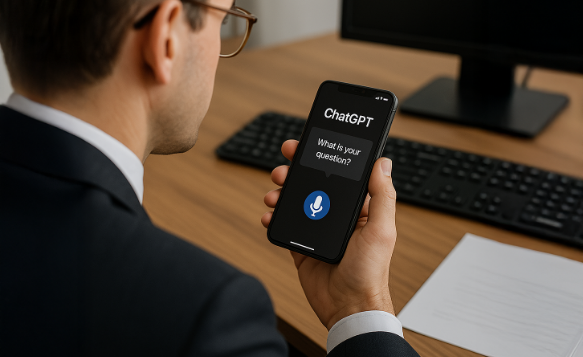
ChatGPT isn't just changing the way people search for information. The platform is also having an increasing influence on how consumers and business decision-makers discover products, services, and suppliers.
In early 2026, OpenAI took an important next step in this regard: the company began running ads in ChatGPT. What started as a limited test in the United States has since expanded to various international markets.
But how exactly do these ads work? How do they differ from Google Ads? And perhaps the most important question for Dutch companies: when can they start using them?
From AI Assistant to Commercial Discovery Channel
Traditional search engines display a list of links. ChatGPT, on the other hand, attempts to provide a direct answer to a question. This creates a different kind of customer journey.
For example, a user doesn't just search for “best CRM for SMBs”—they're having a conversation:
- Which CRM is best suited for a sales team of ten people?
- What are the differences between the available systems?
- Which solution can be implemented quickly?
- What should I keep in mind when it comes to costs?
- Which provider can help me with the design?
During such a conversation, the need becomes increasingly clear. The user isn't just gathering information; they're working step by step toward a decision.
That's exactly where OpenAI sees an opportunity for advertising.
ChatGPT Ads are designed to help businesses gain visibility at moments when users are exploring options, comparing possibilities, or ready to take the next step. The ad is separate from the response generated by ChatGPT.
How did the story of ads in ChatGPT begin?
In January 2026, OpenAI announced for the first time that it planned to begin testing ads. The goal was to keep the free and low-cost versions of ChatGPT accessible, without allowing ads to influence the content of the responses.
On February 9, the first official test began in the United States. Initially, the ads were visible only to logged-in adults with a Free or Go subscription. Users with Plus, Pro, Business, Enterprise, and Education subscriptions did not see any ads.
In March, the service expanded to Canada, Australia, and New Zealand. OpenAI then announced pilot programs in the United Kingdom, Mexico, Brazil, Japan, and South Korea.
On August 11, 2026, OpenAI confirmed that ChatGPT Ads had indeed been launched in these five countries. OpenAI also indicated that it planned to expand into new markets for the remainder of 2026.
The Netherlands is not currently on the list of available countries.
What do ads in ChatGPT look like?
Ads appear below a regular ChatGPT response. They are clearly labeled as sponsored and visually separated from the organic response.
An advertisement may include, among other things:
- the advertiser's name and logo;
- a title;
- A brief description;
- an image;
- a link to a landing page.
The main difference from traditional search ads is the context in which the ad appears. ChatGPT doesn't look solely at a single keyword, but at the intent and content of the current conversation.
A company can add what are called “context hints” in Ads Manager. These allow the advertiser to describe the topics, conversations, or needs to which the ad may be relevant. These are not exact keywords, and they do not guarantee that an ad will be displayed within a specific conversation.
Among other things, the system looks at:
- the context and intent of the conversation;
- the landing page;
- the ad title and text;
- the context provided by the advertiser;
- Additional signals when the user has enabled ad personalization.
As a result, advertising in ChatGPT is less like traditional keyword-based advertising and more like advertising based on situations, needs, and decision-making moments.
Do advertisers have access to conversations?
OpenAI says that conversations are not shared with advertisers. Advertisers do not receive users' chat histories, reminders, names, email addresses, exact locations, or other personal information.
To make ads more relevant, ChatGPT may use internal signals, depending on the user’s settings. These include the current conversation, general location, language, and—if personalization is enabled—previous conversations, memory, and interactions with ads.
According to OpenAI, this information remains within ChatGPT. Advertisers receive aggregated reports, such as impressions, clicks, and conversions.
OpenAI also emphasizes that advertisements do not influence ChatGPT’s responses. This means a company cannot pay to be named as the best supplier in the response itself. An advertisement is a separate paid placement and does not constitute a recommendation by OpenAI.
What advertising options are available?
OpenAI began the pilot with CPM-based buying: cost per thousand impressions. CPC bidding is now also available, whereby an advertiser pays per valid click.
In Ads Manager, businesses can, among other things:
- create campaigns and ad groups;
- select countries;
- set budgets and bids;
- upload ads and images;
- plan and manage campaigns;
- measuring impressions, clicks, costs, and conversions;
- Using UTM parameters;
- Set up conversion tracking using a pixel or the Conversions API.
OpenAI uses a relevance-based second-price auction. As a result, the highest bidder does not automatically win. The expected relevance and value to the user also play a role in the selection of ads.
The self-service environment is still in beta. In addition, OpenAI is collaborating with media agencies and technology partners to give larger advertisers access to the platform.
When will ChatGPT ads come to the Netherlands?
The short and honest answer is: we don't know yet.
On August 18, 2026, Ads Manager will be officially available in:
- Australia;
- Brazil;
- Canada;
- Japan;
- Mexico;
- New Zealand;
- the United Kingdom;
- the United States;
- South Korea.
The Netherlands is not on this list. OpenAI has also not yet announced a specific launch date for the Netherlands or Europe.
OpenAI does say that the advertising program will be expanded to more markets in 2026. This makes a further rollout in Europe likely, but a launch in the Netherlands can only be considered confirmed once OpenAI adds the Netherlands to the official list of available countries.
The fact that the United Kingdom is now supported shows that OpenAI is rolling out its advertising platform outside North America. However, the United Kingdom is not part of the European Union. For the Netherlands, factors such as European privacy regulations, consumer protection, ad transparency, language, billing, and local support may play a role. This is a logical explanation for a phased rollout, but OpenAI has not officially stated that this is the reason for the Netherlands’ exclusion.
For now, Dutch companies can register their interest with OpenAI. However, they cannot yet launch a Dutch campaign directly through Ads Manager as long as the Netherlands is not a supported ad market.
Why is this relevant for Dutch B2B companies?
The introduction of ChatGPT Ads doesn't mean that Google Ads, LinkedIn Ads, or SEO will suddenly become obsolete. It does, however, add a new commercial touchpoint.
With search engines, a company aims to be visible the moment someone enters a search query. In ChatGPT, an ad can appear within a longer conversation in which the user:
- is trying to understand a problem;
- is exploring various solutions;
- compares suppliers;
- discusses the terms and risks;
- is preparing to make a purchase decision.
This is particularly relevant for B2B companies. With complex products and services, the customer journey often involves multiple inquiries. As a result, an ad can tap into a much richer context than a single keyword.
At the same time, relevance is becoming more important. Generic statements like “we offer high-quality, innovative solutions” providelittle guidance for an advertising system. A well-defined value proposition, clear areas of application, and a landing page with strong content will likely be key to achieving good results.
What steps can companies take right now to prepare?
Waiting for the Dutch rollout does not mean that organizations cannot take any action. Companies can already take a number of preparatory steps.
1. Identify common business conversation scenarios
Don't just think in terms of keywords, but especially in terms of questions and situations. What kind of conversations does a potential customer have before reaching out? What problems, alternatives, objections, and selection criteria come up during those conversations?
2. Make the positioning specific
ChatGPT Ads should quickly make it clear within a conversation who a company is relevant to. A general proposition will be harder to link to a specific need.
3. Improve the landing pages
The ad is just the beginning. The page behind the ad must address the user's needs, build trust, and offer a logical next step.
4. Set up conversion tracking properly
Make sure that forms, appointments, downloads, demo requests, and other commercial initiatives are measurable. Without a solid measurement framework, it remains difficult to assess the true value of a new advertising channel.
5. Build subject-matter authority
Paid visibility and organic AI visibility are two different things. An ad does not secure a spot in ChatGPT’s response. Companies must therefore continue to invest in clear, reliable, and substantive content that demonstrates their expertise.
ChatGPT Ads Call for a Different Way of Thinking
ChatGPT Ads aren't just a simple copy of Google Ads. The platform shifts the focus from keywords to conversations and from individual clicks to decision-making moments.
The advertising platform is not yet available to Dutch companies, and no official launch date has been announced. Still, it’s wise to keep a close eye on its development. Once the Netherlands is added, companies with a strong market position, a clear understanding of customer needs, effective landing pages, and reliable conversion tracking will likely have a head start.
The most important part of preparation, therefore, isn't writing ads in advance. It's understanding the conversations your customers are having before they make a decision—and ensuring that your brand has a relevant and credible response at that moment.
Do you want to be prepared for advertising and search visibility within AI?
TMC Media helps B2B companies and organizations in the manufacturing industry with digital strategy, AI visibility, conversion-focused websites, online marketing, and measurable lead generation.
Would you like to know how your organization currently appears within AI-driven customer journeys and what improvements are needed? Contact TMC Media for a no-obligation assessment.
Relevant blogs








































Interested in digital growth for your industry?
Strengthen your online presence and expand your market reach with TMC Media. We combine strategic thinking with innovative creativity to deliver measurable results. From conversion-focused websites to targeted online marketing campaigns—we’re your digital growth partner.
Contact us for a no-obligation consultation
